Heavy-traffic driveways fail prematurely without proper foundation work and material selection. The key is evaluating load requirements, compacting soil thoroughly, and installing a 4-6 inch base layer of crushed limestone or recycled asphalt that interlocks effectively. Concrete outperforms asphalt for longevity, lasting 30-40 years versus asphalt’s 15-20 years, though reinforcement systems, drainage design, and seal coats further extend durability. Regular maintenance schedules prevent deterioration patterns common in high-use environments, transforming a potential liability into decades of reliable performance. Understanding these interconnected strategies reveals why some driveways crumble while others endure.
Expert Highlights
- Assess load requirements and traffic patterns to select appropriate materials and prevent premature pavement deterioration.
- Compact subgrade foundation using plate compactors and conduct soil testing to ensure adequate bearing capacity.
- Install 4-6 inch well-compacted base layer of crushed limestone or recycled asphalt for superior weight distribution.
- Choose concrete over asphalt for heavy traffic, as it provides 30-40 year lifespan with minimal maintenance.
- Implement reinforcement systems, proper drainage design, and regular seal coating to extend pavement durability significantly.
Understanding Load Requirements and Traffic Patterns

Every driveway faces a critical challenge: determining how much weight and how many vehicles it must support without deteriorating prematurely. Heavy-traffic driveways endure significantly more stress than residential ones, requiring builders to assess load requirements—the maximum weight vehicles will place on the surface—and traffic patterns, which measure frequency and vehicle types. A delivery truck weighing 26,000 pounds creates vastly different demands than a family sedan. Understanding these factors prevents costly failures like cracking, rutting, and premature breakdown. Builders must evaluate local conditions, anticipated vehicle frequency, and seasonal variations to design appropriate foundations and surface materials. This analysis directly determines lifespan and maintenance costs, making it essential groundwork before construction begins. Proper assessment guarantees driveways withstand years of demanding use without expensive repairs or complete replacement.
Preparing and Compacting the Sub-grade Foundation

A durable heavy-traffic driveway begins beneath the surface, where soil assessment and analysis determine whether the foundation can handle the weight and stress of constant vehicle pressure. The subgrade must be properly compacted using appropriate equipment—such as plate compactors for smaller areas or vibratory rollers for larger sections—to eliminate air pockets and weak spots that would otherwise cause settling, cracking, and premature failure. Simultaneously, drainage preparation and strategic grading work together to direct water away from the foundation, preventing moisture accumulation that weakens soil integrity and compromises the entire structure’s longevity.
Soil Assessment and Analysis
Before any driveway can support heavy vehicles without cracking, settling, or failing prematurely, the soil beneath it must be thoroughly evaluated and properly prepared, since the subgrade foundation—the layer of compacted soil directly under the pavement—determines whether your driveway will last decades or deteriorate within years. Professionals conduct soil testing to identify clay content, moisture levels, and bearing capacity; poor-quality soil causes catastrophic failure when eighteen-wheelers roll overhead. Solutions include removing problematic soil and replacing it with properly graded materials that compact uniformly. Engineers measure soil density using specialized equipment, ensuring ideal compaction percentages. This strategic assessment prevents expensive repairs later and guarantees your driveway withstands constant heavy traffic without buckling or developing potholes that swallow small vehicles whole.
Compaction Equipment and Methods
Proper compaction transforms loose, uneven soil into a dense, stable foundation capable of supporting heavy vehicles repeatedly without settling or shifting, yet many driveway projects fail because contractors skip this critical step or use inadequate equipment that leaves air pockets and weak spots throughout the subgrade. Vibratory plate compactors efficiently compress soil layers, while roller compactors handle larger areas cost-effectively. The solution involves multiple passes—typically three to five—gradually building density without over-compacting, which can cause brittleness. Testing soil moisture guarantees ideal compaction; too dry means poor bonding, too wet causes displacement. Proper compaction prevents rutting, cracking, and expensive repairs, delivering driveways that withstand years of heavy truck traffic and environmental stress.
Drainage Preparation and Grading
Once the subgrade achieves proper compaction, water management becomes the next critical priority, because even the densest foundation fails when moisture accumulates beneath the surface and destabilizes the soil structure. Proper grading directs water away from the driveway, preventing pooling that weakens the base. Contractors should establish a slight slope, typically one-quarter inch per foot, channeling water toward drainage systems or natural slopes. French drains or perforated pipes beneath the surface layer capture groundwater before it damages the foundation. Without adequate drainage, freeze-thaw cycles crack pavement as trapped water expands when frozen. Strategic grading combined with subsurface drainage systems guarantees long-term stability, reducing costly repairs and extending driveway lifespan considerably.
Selecting the Right Base Layer Materials
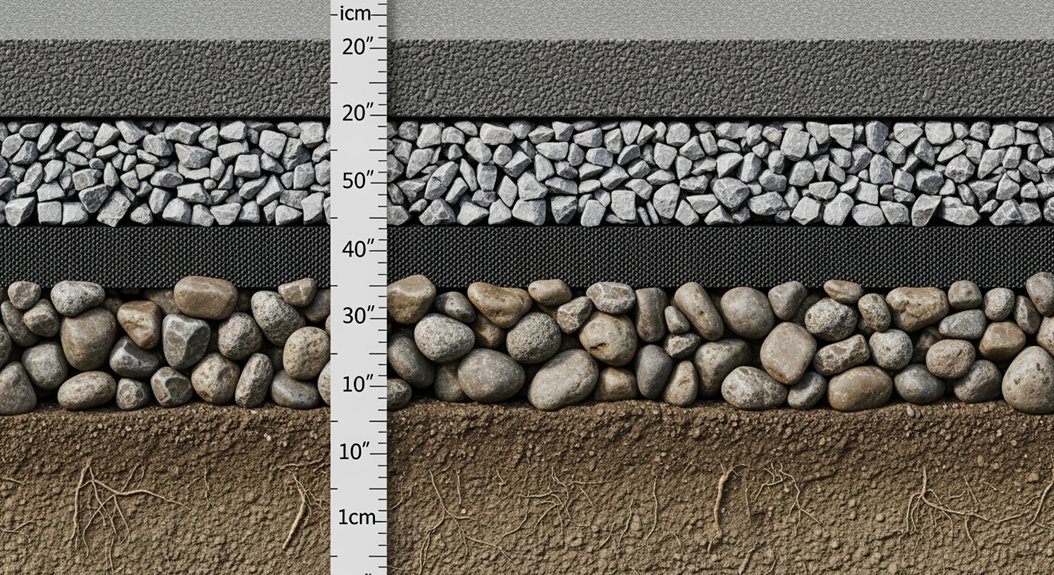
Since driveways must support the constant weight of vehicles—from daily commutes to delivery trucks—the foundation layer beneath the surface asphalt or concrete becomes the critical difference between a driveway that lasts decades and one that cracks and crumbles within years. Without proper base materials, even premium surface coatings fail prematurely. Crushed stone or gravel alone compacts unevenly, creating weak spots where water infiltrates and soil beneath shifts. The solution requires selecting crushed limestone or recycled asphalt, which interlock effectively and shed water efficiently. A well-compacted four to six-inch base layer distributes vehicle weight across a broader soil area, preventing the settlement that triggers surface cracking. This foundation investment directly extends driveway lifespan by fifteen to twenty years, making it essential groundwork.
Choosing Between Asphalt and Concrete for Heavy Use
When heavy vehicles regularly traverse a driveway, asphalt and concrete each respond differently to the stress and strain, with asphalt typically showing flexibility under load but requiring more frequent maintenance, while concrete offers superior longevity and can withstand decades of heavy traffic with minimal repair needs. Asphalt’s softer composition allows it to flex with temperature changes and vehicle weight, preventing cracking in many cases, yet this same quality means the surface can develop ruts, potholes, and surface deterioration within 15–20 years under consistent heavy use. Concrete, by contrast, maintains its structural integrity for 30–40 years or longer when properly installed and sealed, making it the more durable choice for commercial or industrial driveways despite higher upfront costs and potential cracking issues in extreme freeze-thaw climates.
Asphalt Durability Under Load
Heavy traffic—whether from delivery trucks, construction equipment, or regular commercial vehicles—places immense stress on driveway surfaces, and the choice between asphalt and concrete fundamentally determines how well a driveway will withstand this punishment over time. Asphalt, composed of bitumen and aggregate, flexes under weight rather than cracking, making it initially forgiving for heavy loads. However, this flexibility becomes problematic as repeated stress weakens the binder, causing rutting and accelerated deterioration. Under constant pressure, asphalt typically lasts 15-20 years before requiring major repairs, whereas concrete can endure 30-40 years. The solution involves choosing asphalt primarily for moderate traffic or combining thicker base layers—8 inches minimum—with high-quality bitumen to extend durability greatly, providing better long-term value despite higher upfront costs.
Concrete Longevity Comparison
Concrete’s superior lifespan makes it the logical choice for driveways bearing constant commercial traffic, yet this advantage comes with specific conditions that property owners must understand to realize its full potential. While concrete typically lasts 30-40 years compared to asphalt’s 15-20 year lifespan, heavy vehicles create stress fractures and spalling—surface deterioration that requires preventive maintenance. The solution involves proper installation with adequate thickness (4-6 inches for commercial use), reinforced steel mesh, and high-quality cement mixtures. Additionally, applying sealant every 2-3 years protects against moisture penetration and chemical damage from road salts. Though concrete demands higher upfront investment, its extended durability and reduced maintenance frequency deliver substantial long-term savings, making it the economically superior choice for heavy-traffic applications.
Installing Reinforcement Systems for Added Strength
Most driveways experience stress from the constant weight of vehicles, freeze-thaw cycles, and shifting soil beneath the surface, all of which create cracks and eventually lead to costly repairs or complete replacement. Reinforcement systems solve this problem by distributing loads more evenly across the driveway surface.
Effective reinforcement options include:
- Rebar installation – Steel bars placed in a grid pattern throughout concrete, greatly increasing tensile strength and crack resistance
- Wire mesh integration – A lattice framework that prevents surface cracks from spreading deeper into the foundation
- Fiber additives – Synthetic or polypropylene fibers mixed into concrete that reduce shrinkage-related cracking by up to 40%
These systems work together to extend driveway lifespan from 25 years to 40+ years, dramatically reducing maintenance costs and preventing premature failure from heavy vehicle traffic.
Proper Drainage Design to Prevent Premature Failure
While reinforcement systems strengthen the concrete structure itself, water damage represents an equally serious threat that can undermine even the most robustly built driveway from beneath the surface. Without proper drainage, water infiltrates cracks and seeps beneath the pavement, causing expansion cycles that crack concrete and erode the base layer. This leads to potholes, surface deterioration, and costly repairs.
Effective drainage solutions redirect water away from the driveway through strategic slope design—typically a two-percent grade—ensuring water flows toward designated drainage areas. Installing permeable base materials, French drains, or subsurface drainage systems captures water before it accumulates. Sloped edges and crowned centers prevent pooling. These measures greatly extend driveway lifespan by protecting against frost heave, freeze-thaw damage, and base material weakening, ultimately safeguarding your investment.
Applying Seal Coats and Protective Treatments
The exposed surface of a driveway faces relentless assault from UV rays, chemical spills, moisture penetration, and traffic wear that gradually break down the concrete’s protective outer layer. Without intervention, these elements cause cracking, fading, and structural deterioration within years.
Seal coats and protective treatments act as armor, extending driveway lifespan enormously:
- Acrylic sealers provide affordable UV protection and water resistance, requiring reapplication every 2-3 years
- Polyurethane coatings offer superior durability and chemical resistance, lasting 5-7 years with minimal maintenance
- Epoxy treatments deliver maximum protection against oil stains and heavy traffic, though requiring professional application
Applying these protective barriers prevents water from infiltrating concrete’s pores, where freeze-thaw cycles cause expensive damage. Regular maintenance transforms a deteriorating surface into a resilient investment that withstands decades of demanding use.
Managing Temperature and Weather Considerations
Concrete driveways expand and contract dramatically with temperature swings, creating internal stress that leads to cracking, buckling, and surface deterioration if not properly managed during construction and maintenance. Builders must install expansion joints every 4 to 6 feet, allowing concrete to move freely without fracturing. During winter, salt and moisture penetrate surface pores, freezing and thawing in destructive cycles that chip away at the top layer—a process called spalling. Applying seal coats before winter arrives creates a protective barrier, reducing water absorption by up to 90 percent. Summer heat requires different strategies: scheduling pours during cooler months prevents rapid curing that causes premature cracking. These temperature-conscious practices considerably extend driveway lifespan, protecting heavy-traffic surfaces from costly premature failure.
Establishing a Regular Maintenance Schedule
A well-maintained driveway requires systematic inspections at key seasonal changes—spring to assess winter damage like cracks and potholes, summer to evaluate UV deterioration and seal coat integrity, fall to clear debris that traps moisture, and winter to monitor freeze-thaw cycles that can expand existing fractures. Establishing repair frequency guidelines based on traffic volume and surface condition prevents small issues from escalating into expensive structural failures; for instance, addressing a hairline crack within weeks costs substantially less than replacing a section damaged by water infiltration and base erosion. Regular maintenance schedules extend driveway lifespan by 5-10 years compared to reactive repairs alone, reducing long-term costs while maintaining safe driving surfaces for heavy commercial and residential traffic.
Seasonal Inspection Protocols
Since heavy-traffic driveways experience continuous stress from vehicle weight, temperature fluctuations, and environmental exposure, they require systematic inspections at key times throughout the year to catch problems before they escalate into costly repairs. Property owners face considerable challenges when seasonal changes damage asphalt or concrete, leading to potholes, cracks, and structural failure that compromise safety and increase expenses dramatically.
Strategic inspections prevent these disasters:
- Spring assessments reveal winter damage, including freeze-thaw cracks and salt deterioration, allowing immediate patching before traffic worsens conditions
- Summer evaluations identify heat-induced expansion problems and surface softening that threaten pavement integrity
- Fall inspections address drainage issues before winter precipitation arrives, preventing water infiltration that destroys underlying layers
Implementing quarterly protocols protects long-term driveway investment, extending lifespan substantially and reducing emergency repair costs while maintaining safe driving conditions throughout all seasons.
Repair Frequency Guidelines
Heavy-traffic driveways deteriorate faster than residential surfaces because constant vehicle pressure compounds damage from weather and age, meaning property owners must establish repair schedules based on specific conditions rather than generic timelines. High-traffic areas typically require inspections every three to six months, while standard driveways need yearly checks. Cracking, pothole formation, and surface spalling signal immediate repair needs that, if ignored, create expensive structural damage requiring full replacement. Property owners should document damage progression through photos and notes, enabling contractors to prioritize repairs effectively. Regular maintenance—filling cracks within weeks of detection, sealing surfaces annually, and patching potholes promptly—prevents minor issues from escalating into major expenses. This proactive approach extends driveway lifespan considerably while maintaining safe driving conditions and protecting property value.
Addressing Common Heavy-Traffic Wear and Repair Issues
Most driveways exposed to constant vehicle pressure experience predictable deterioration patterns that, if left unaddressed, escalate from minor surface damage into structural failure requiring complete replacement.
Heavy-traffic driveways typically develop these issues:
- Alligator cracking: A spider-web pattern forms when the surface layer separates from its base, usually caused by repeated heavy loads weakening the bond between layers
- Rutting and deformation: Tire tracks create permanent grooves as the material compresses under consistent weight, indicating subbase failure
- Edge breaking: Unsupported edges crumble when trucks overhang pavement boundaries, exposing vulnerable shoulders to moisture infiltration
Addressing these problems promptly prevents cascading damage. Seal-coating catches early cracks before they widen, while proper drainage management diverts water that accelerates deterioration. Strategic reinforcement with thicker asphalt or concrete bases distributes heavy loads more effectively, substantially extending pavement lifespan and reducing long-term repair costs.
Frequently Asked Questions
What Is the Typical Lifespan of a Heavy-Traffic Driveway Before Complete Replacement?
Heavy-traffic driveways typically survive 15-20 years before surrendering completely to the relentless assault of vehicles and weather. Of course, one could always pray for miraculous asphalt resurrection.
How Much Does It Cost to Build a Durable Driveway for Heavy Commercial Use?
Heavy commercial driveway construction typically costs $8,000 to $25,000, depending on size and materials. Basically, expect to spend enough money that you’ll genuinely weep when the first pothole appears anyway.
Can Existing Driveways Be Reinforced to Handle Increased Heavy Traffic Loads?
Existing driveways can absolutely be reinforced, though they’ll probably need more therapy than a reality TV star. Overlays, concrete injection, and steel reinforcement turn wimpy surfaces into traffic-crushing champions ready for the heavy hitters.
What Permits or Regulations Apply to Commercial Driveway Construction in My Area?
Commercial driveway permits typically require zoning approval, structural engineering plans, and drainage assessments. One must contact local building departments—those delightfully bureaucratic gatekeepers—who’ll demand proof that vehicles won’t accidentally achieve flight through faulty construction.
How Do I Know if My Driveway Can Safely Support Specific Vehicle Weights?
One consults a structural engineer who’ll poke the pavement with fancy instruments and deliver sobering news about one’s asphalt’s weight-bearing capacity, assuming it doesn’t just giggle nervously under pressure.
Expert Final Thoughts
Building durable driveways for heavy traffic requires understanding load demands, preparing solid foundations, selecting appropriate materials like reinforced concrete or quality asphalt, and implementing protective treatments. Regular maintenance—including seal coating and prompt repairs—prevents costly deterioration from vehicle wear and weather exposure. By following these systematic steps, property owners establish surfaces capable of withstanding years of intensive use while minimizing long-term repair expenses and safety hazards.